Subscribe For Free Updates!

We'll not spam mate! We promise.

Showing posts with label INDIA. Show all posts

The rape victim that India forgot

Beneft of media attention, minor girl fights lonely battle and awaits 20th surgery after being gang-raped 16 months ago.

Charges of rape have been brought against only two men, though the girl said she was raped by six [Al Jazeera]
Not far away from where hundreds marched and held candle-lit vigils in memory of a medical student who died after a brutal gang-rape in the capital New Delhi exactly a year ago, the 12-year-old lay in a room, forced to come to terms with her wounds and plight virtually alone.
Gang-raped some sixteeen months ago and having undergone 19 reconstructive surgeries, there has been little or no outpouring of sympathy and public support for her.
"These sixteen months have been the worst in in life. I am dying every single day. My life has been ruined, body violated. The pain is unbearable, but I am yet to get justice," she says.
"Will you help me to get justice?" she asks the correspondent.
Spotlight
Follow our special India coverage
While last December's  Delhi gang-rape victim consumed the nation bringing along with it changes in law to deal with sexual abuse and aroused people's conscience, this minor girl has received no attention from anyone. She was raped four months before the Delhi incident.
Her case is yet to be tried in court.
"These 16 months have been the worst in my life. I am dying every single day. My life has been ruined, body violated, the pain is unbearable, but I am yet to get justice,"... Will you help me get justice?"
Rape survivor 
She has been crying for help. But it seems like the protesters who took on the streets of Delhi like a storm, have turned a deaf ear to her pleas. None visited her even on Monday, the first anniversary of the Delhi rape.
The minor girl has been waiting at the Rajasthan Bhavan - official guest house of the state of Rajasthan - in New Delhi for 10 months to undergo her 20th operation in January.
Since her rape in August 2012, many high profile cases of sexual abuse have come to the fore, with public indignation forcing the authorities to act. A high-profile preacher is in jail for alleged rape. A top-notch magazine editor has been thrown behind bars for sexual misconduct with a fellow journalist. Three of the accused in the Delhi rape have also been sentenced to death.
However, justice has remained elusive for this unfortunate girl, who is not being named to maintain her privacy.
Hailing from a family of daily labourers she was raped on Eid, a day of celebration. Recounting her day of horror, she says, "They took me to a forest and kept slapping me as they violated my body. They were six people. Initially I screamed for help, but later I lost consciousness and could not remember anything. Next evening, I found myself on a deserted road."
Recounting their journey since then, the rape survivor's sister says, "She had been brought to Jaipur and admitted in JK Lone (a paediatric hospital). Her condition was so terrible that doctors could not say anything for some time."
Dr L D Agrawal, who treated the girl for seven months in JK Lone says, "Normally, it takes us a few minutes to understand the case. But, in this case, we took more than half an hour to arrive to a conclusion on how we could restore her private parts. The septum separating the vagina and anus had been severely ruptured."
But even after undergoing 17 surgeries, her condition did not improve and she was taken to the Delhi-based All India Institute of Medical Science (AIIMS), where she went two major operations. "At AIIMS, doctors had told us that some unnecessary operations were done in Jaipur," alleges her sister.
Only relief
The only relief was a compensation from the government of western Rajasthan state of Rs five lakh ($ 5106), which was deposited in the bank account of the survivor. However, nothing much has been done to jail the accused.
"The accused are associated with a minister. In this case, as the victim was poor and it happened in a small town, neither civil society nor the media has paid much attention to her plight,"
Naseema Khatoon, social activist
"Since the beginning, the police have been lenient towards the culprits. As soon as she had been kidnapped, her family had informed the police, but the police didn't act immediately. Later, she was found deserted after being raped. Though the accused were identified, the police failed to arrest them immediately," says Naseema Khatoon, a social activist, who has been fighting for justice to the survivor.
"Eventually, when the police arrested the six accused, they granted bail to two at the police station itself. Even after taking the victim and her family's statement, police registered a weak case. And most importantly, charge of rape has been slapped only against two, instead of all six," she pointed out.
The trial is yet to begin. Police here say the reason is because of delay in identification of the accused by the survivor.
"As soon as she gets well, we will bring her to Sikar for the identification parade," said officer Seema Hingonia.
When asked why rape charges had been framed only against two, the police officer excused herself saying she would be able to comment only after looking through her file.
"The accused are associated with a minister. In this case, as the victim was poor and it happened in a small town, neither civil society nor the media has paid much attention to her plight," laments Khatoon.

India planning a 'separation wall' in Kashmir


India plans to build a separation wall in the Himalayan region, but rebels have warned against such a move.


The proposed separation fence aims to halt 'illegal crossing' by rebel groups into Indian-administered Kashmir [Reuters]
Taking a cue from Israel's proposed separation wall along the Jordanian border, India plans to build a similar but higher 179km long wall in the Indian-administered Kashmir to separate the southwestern portion of the disputed region from Pakistan.
Pakistan and rebel groups fighting in the disputed Himalayan region have, however, warned against such a move.
According to Indian officials, the wall would pass through 118 villages within the three districts of disputed Kashmir and would be 41 meters wide and 10 meters high to accommodate bunkers and check posts.
"It would be one of the most significant Border Guarding System in the country which has not been experimented or created in India before," Dharminder Parikh a top official of India's Border Security Force (BSF) told Al Jazeera.
Follow our special coverage
The BSF official said the fence would help "stop the illegal crossing by militants" and the requisition of land was sent to the Indian-administered Kashmir government in 2012 but "we have come to know that they there is still some land which has to be bought from the villagers for construction purposes."
Kashmir, a disputed Himalayan region, is divided between nuclear-armed India and Pakistan by a de facto border called Line-of-Control (LoC) and further in the Southwest by a serpentine Ceasefire Line which New Delhi calls the International Border with Pakistan.
The LoC has been coiled by India with several metres high double-row concertina-wire fencing to block armed rebels from entering and launching attacks on Indian soldiers inside Indian-administered Kashmir. The wall always remains electrified and is linked with what many believe are Israeli-made surveillance devices.
Both the South Asian rivals have fought two of their three wars over the disputed Muslim-majority territory and have yet to tackle the core issues of the Kashmir dispute, control and sovereignty of the Himalayan region.
India's plan of construction of a concrete wall along the Line of Control (LoC) on pattern of Berlin Wall Shah is unacceptable.
- Shabir Shah, Kashmir pro-independence leader
Pakistan controls almost 33 percent of Kashmir, India about 45 percent and China the rest.
Muslim-armed rebels from almost 14 groups are fighting Indian soldiers in Kashmir since 1989 in a confrontation aimed at independence of Kashmir or merger of the territory with Pakistan.
New Delhi often accuses Islamabad of fomenting unrest in Indian-administered Kashmir - a charge Islamabad denies.
Pakistan says it offers moral, political and diplomatic support to Kashmiris fighting against Indian rule.
Both countries have held the decade old ceasefire but sporadic skirmishes are common. Recently both countries traded blame over ceasefire violations along the de facto border in Kashmir.
On September 26, at least 12 people, including four policemen, six army personnel and a colonel were killed when armed rebels raided a police station in Kathua district and later an army camp in the adjoining Samba district. The attackers were believed to have snuck through the Ceasefire Line.
On October 23, Indian officials said Pakistani rangers fired at over 50 positions in the Samba sector, where the wall is coming up, which was "the most extensive ceasefire violation in one night in the past two decades".
Thwarting infiltrations 
Indian officials say they plan to dig a parallel trench along the wall and add a multi-tier screening system to thwart "infiltrations and ceasefire violations" in the area.
An official of Indian interior ministry confirmed to Al Jazeera that the barrier will come up because of security issues and the total cost is still under consideration.
"Security is the most important aspect of it [the fence]. It is a joint project of the Home Ministry, Defence Ministry and the government of Jammu and Kashmir. The total cost on the project is yet to be outlined," said K S Dhatwalia, Additional Director General (Media) of the Indian Home Ministry.
An email questionnaire sought by the Dhatwalia for more details on the project, however, elicited no response. But there are growing fears that farmers will be losing prime land to the fence.
"They have already built a fence on the zero line. Now they want to build this wall very much inside the Indian territory which will not benefit the farmers," says Sham Lal Chowdhary, a pro-Indian politician in the region.
"The farmers have not been compensated for the lands under [existing] fencing and mining areas. They cannot grow crops. This embankment would further squeeze their earnings," he added.
Replica of Israeli separation wall
The plan to erect an all-weather fence along the 740km long LoC that divides mountainous region into Pakistan-administered Kashmir and Indian-administered Kashmir was also presented to then India's Home Secretary R K Singh in 2012, according to defence sources.
That year, a top police officer - who visited Israel and observed the efficacy of the fence along Israeli-Palestine barrier - insisted that the replica of such a fence in disputed Kashmir was possible.
India's plan of construction of a concrete wall along the Line of Control (LoC) on pattern of Berlin Wall Shah is unacceptable.
Shabir Shah, pro-independence leader
"But the plan was disliked by the Indian army," sources say adding, "Army officials present in the meeting raised concerns. Their point was that an all weather fencing would isolate villages permanently along the LoC and would also mean giving away large tracts of land along the border."
Officials of the Indian army, sources say, had argued that the terrain and geography in Kashmir makes it much "tougher to replicate" the Israeli-Palestinian separation wall.
The new wall, which is coming on the largely flat areas of the disputed region, has, however drawn criticism from various groups including rebel groups and pro-independence political parties in the disputed Kashmir.
"India's plan of construction of a concrete wall along the Line of Control (LoC) on pattern of Berlin Wall Shah is unacceptable," said Shabir Shah, a pro-independence leader in India-administered Kashmir.
Shah, who is also known as the "Nelson Mandela" of Kashmir for having spent over 25 years in Indian jails said, "The 21st century is not for building political walls along borders but to dismantle them."
The chief of United Jihad Council (UJC) - an umbrella of fourteen rebel groups fighting against New Delhi's rule in Kashmir - Syed Sallah-ud-Din, in a statement sent to Al Jazeera, said that the move "aimed at converting Kashmir into a prison".
"Construction of the wall along LoC is like the Berlin wall and is aimed to make the occupation of India permanent in Kashmir but the move will be opposed on all the fronts," the group's statement said.
Others have called New Delhi's move a "regressive nostalgia".
"India's fresh bid to construct a long wall along the divided border is a sign of regressive nostalgia. History is replete with instances where walls have been built to preserve occupied lands but without any success. The Berlin wall fell like a pack of cards and occupation of Palestine has not made the citizens of 'Israel' any safer than before", argues Abdul Majid Zargar, a Kashmiri columnist.
Pakistan too has warned that such a move by India will be a "unilateral" one. On Thursday, the Pakistan PM's Advisor on Foreign Affairs and National Security Sartaj Aziz said, "Any unilateral action in this regard by India cannot declare the LoC as permanent border."
The state-run Radio Pakistan quoting Aziz said Pakistan has not received any information from India about the construction of a structure like the Berlin Wall along the LoC.

Additional reportage by Wasim Khalid

India-US row escalates over diplomat's arrest


Indian leaders boycott US congressional delegation and initiate retaliatory steps over arrest of diplomat in New York.

Last updated: 17 Dec 2013 11:50

Devyani Khobragade was arrested and handcuffed over an alleged visa fraud [Facebook]
The simmering tension between New Delhi and Washington over the arrest of an Indian diplomat in New York has escalated into a major row with the boycott of a visiting US Congressional delegation by India's political leaders.
India has also asked all US diplomats stationed in India to turn in their identity cards. Police barricades outside the US embassy in New Delhi have been removed and access for US diplomatic staff to airports curtailed. More retaliatory measures are expected, reports said.
Follow our special India coverage
On Tuesday, Congress vice-president Rahul Gandhi and federal home minister Sushilkumar Shinde refused to meet the visiting delegation in protest against the "despicable and barbaric" treatment meted to the arrested diplomat Devyani Khobragade in New York.
The five-member delegation to New Delhi, facing a general boycott, is led by Congressman George Holding, representative for North Carolina's 13th congressional district, who serves on the foreign affairs committee and judiciary committee. The four other Congressmen are Pete Olson, David Schweikert, Robert Woodall and Madeliene Bordallo.
News of Khobragade being lodged in a prison cell in the company of drug addicts and being subject to a strip search have angered India's mandarins and political bosses. The diplomat was also subject to a DNA swab.
The spat between the United States and India strikes a discordant note at a time when relationship between the two countries is otherwise on a high, especially in the last one decade which has seen unprecedented cooperation in various areas of civilian and defence sectors.
Reacting to the Khobragade's incarceration, India's national security adviser Shiv Shankar Menon described the treatment as "despicable and barbaric."
Media reports quoting Indian government sources said New Delhi is considering "reciprocal steps" later on Tuesday so as to "convey a clear message that this treatment of the diplomat is unacceptable."
On Monday, speaker of the lower house (Lok Sabha) of India's parliament Meira Kumar declined to meet the visiting US congressional delegation.
Handcuffed in public
The Indian diplomat, aged 39, was arrested on Thursday last as she was dropping her daughter to school. She was handcuffed in public and later freed on bail worth $250,000.
US police accuse Khobragade of lying in her visa application for the purposes of recruiting an Indian national who was employed as housekeeper at her home and was paid less than $ 4 an hour, which is lower than US minimum wages.
Her father Uttam Khobragade, a former IAS officer, was quoted by the NDTV news channel as saying, "My daughter is brave, but I'm worried. There's more than what meets the eye."
After her arrest, India's foreign secretary Sujatha Singh summoned the US envoy in New Delhi, Nancy Powell, and protested over the "unacceptable treatment" meted out to Khobragade, a senior consular officer.
The US has defended its actions saying its Marshals followed standard procedures. Countering India's stand that the arrest flouted the Vienna convention governing diplomatic immunity, the US said diplomats enjoyed immunity from their courts only in the exercise of their consular functions.
India has said even if a diplomat is arrested for a purported serious crime, all courtesies must be extended to the diplomat and not be treated like a common criminal.

In Pictures: Kitchen that feeds 100,000 daily


Two hundred thousand rotis (Indian flat bread), 1.5 tonnes of dal (lentil soup) and free food served to 100,000 people everyday are what makes the free kitchen run at the Golden Temple in the western Indian city of Amritsar stand apart.
By all measures, the kitchen (called langar in Punjabi ) is one of the largest free kitchens to be run anywhere in the world.
The concept of langars was initiated centuries ago by Guru Nanak, the founder of Sikh religion.
Sunday, November 17, is his 545th birth anniversary.
At the Langar, no one goes hungry - and everybody gets a hot meal regardless of caste, creed and religion.
All Sikh Gurudwaras (places of worship) have langars, but the one at Golden Temple - Sikhs' holiest shrine - has little parallel.
“Anyone can eat for free here and on an average we serve food to 100,000 people. On weekends and special occasions double the numbers of people visit the langar. The langar never stops and on an average 7,000 kg of wheat flour, 1,200 kg of rice, 1,300 kg of lentils, 500 kg of ghee (clarified butter) is used in preparing the meal every day,” says Harpreet Singh, manager of this huge kitchen.
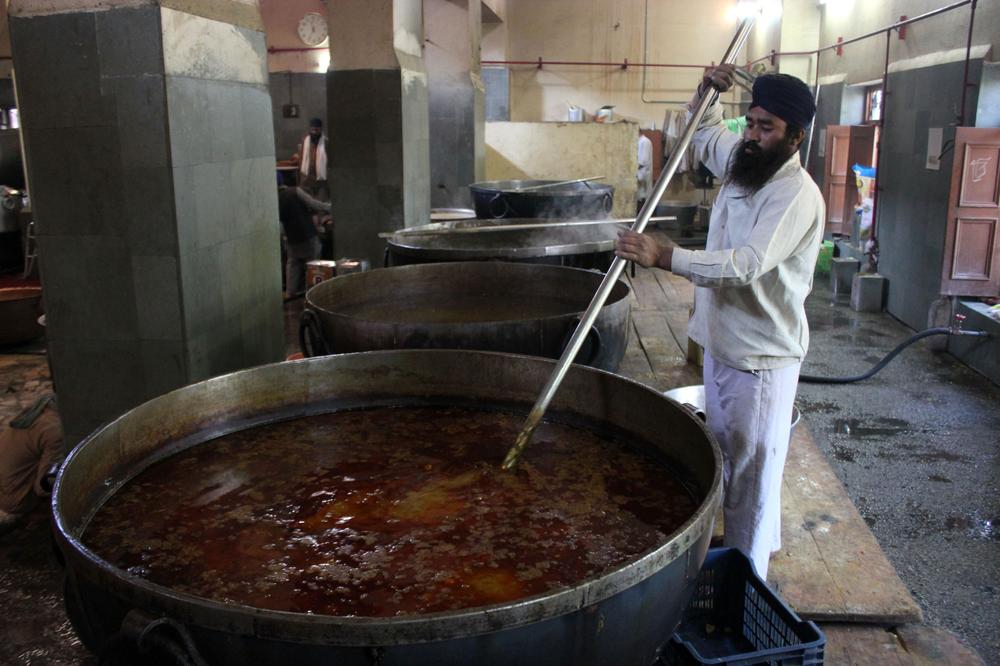
“The free kitchen uses firewood, LPG gas and electronic bread makers for the cooking and we use around 100 LPG cylinders and 5,000 kilograms of firewood every day,” he adds.
The kitchen is run by 450 staff, helped by hundreds of other volunteers.
Sanjay Arora, 46, from New Delhi, comes to volunteer at the langar two days a month. “This is seva (service) for me. I feel happy after doing this service. This is not just free food because here you forget all the differences that separate humans from each other,” he says.
Volunteers also wash the 300,000 plates, spoons and bowls used in feeding the people. The food is vegetarian and the expenses are managed through donations from all over the world. 
The yearly budget of the langar runs into hundreds of millions.

/Showkat Shafi
The "langar" or free kitchen at Golden Temple in the Indian city of Amritsar is perhaps the world’s largest free eatery. The Langar or free kitchen was started by the first Sikh Guru, Guru Nanak


/Showkat Shafi
Around one hundred thousand (100,000) people visit the langar every day and the number increases on weekends and special days.


/Showkat Shafi
People from all over the world especially " Sikhs" visit Golden temple at least once in their life time.


/Showkat Shafi
Everybody is welcome at the langar, no one is turned away. It works on the principle of equality between people of the world regardless of religion, caste, colour, creed, age, gender or social status.


/Showkat Shafi
People sit on the floor together as equals and eat the same simple food at the eating hall of the Golden Temple langar.


/Showkat Shafi
Langar teaches the etiquette of sitting and eating in a community situation.


/Showkat Shafi
People from any community and faith can serve as volunteers.


/Showkat Shafi
The lines of status, caste and class vanish at the langar. Everybody is treated as equals.


/Showkat Shafi
The meal served is hot but simple: comprising roti (flat Indian bread), lentil soup and rice.


/Showkat Shafi
The utensils are washed in three rounds to ensure that the plates are perfectly clean to be again used.


/Showkat Shafi
Running the kitchen also means washing and cleaning thousands of plates, bowls and spoons.


/Showkat Shafi
Some 450 staff and hundreds of volunteers help to run the kitchen.


/Showkat Shafi
Five thousand kilograms of fire wood is used every day for preparing the meals at this langar, that runs 24/7.


/Showkat Shafi
A Sikh volunteer prepares the dal (lentil soup) that will be served for the meals at the langar.


/Showkat Shafi
Around 200,000 rotis are prepared every day at the langar which is served to the people.


/Showkat Shafi
Wheat flour being put in a contraption that acts like a dough maker. The dough will be used for making rotis (Indian flat bread).


/Showkat Shafi
Rotis (Indian flatbread) are cooked over electric machine .


/Showkat Shafi
Women play an important role in the preparation of meals. Volunteers make stacks of rotis that will be served at the free kitchen.